
Home › Guides › 12V sprayer pumps
Best 12V Pump for a Sprayer Tank
How to choose one and set it up · Updated October 18, 2026
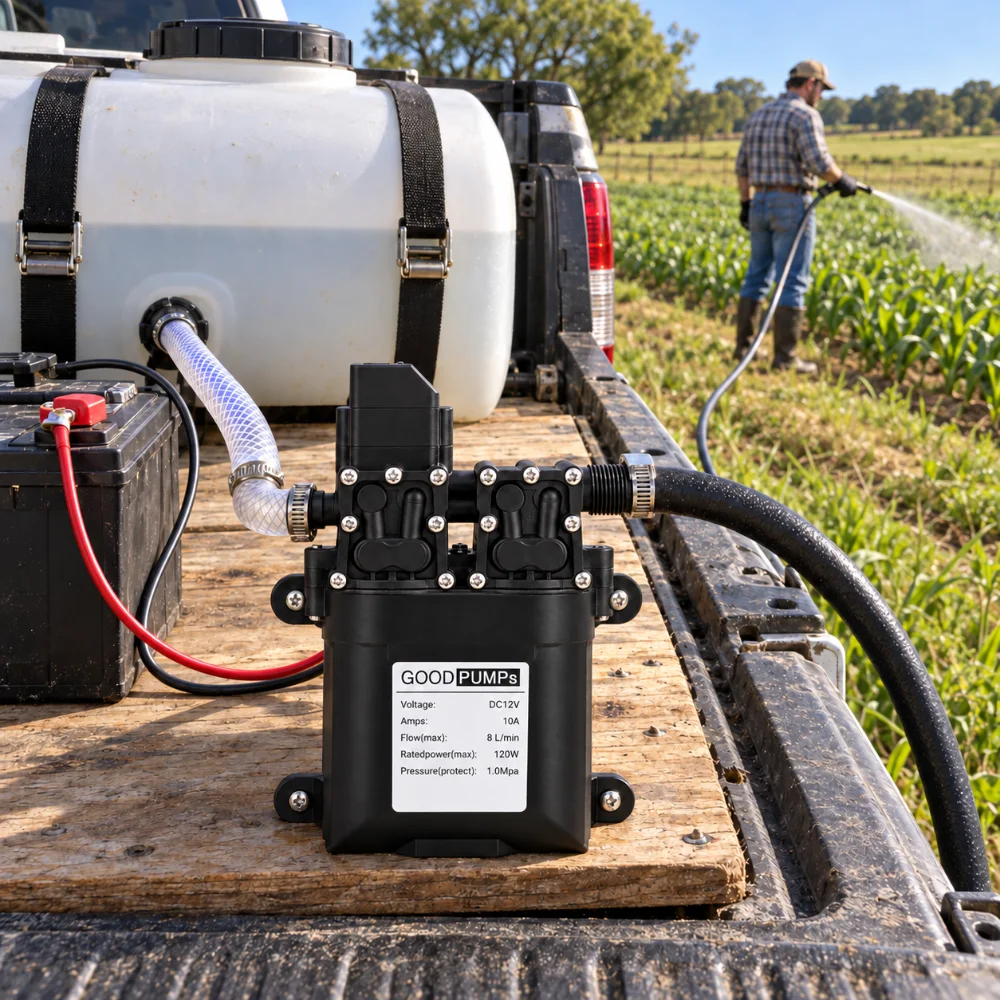
ATV and UTV sprayers, truck-bed tanks, spot sprayers on a cart: almost all of them run on a 12V diaphragm pump. The right pump depends less on the size of your tank than on how you spray. Here's what to look at, which pump fits which job, and how to put it together.
- Spot spraying with one hand wand (weeds, fence lines, garden rows): a 1.3–1.6 GPM pump with a pressure switch, like the GOODPUMPS Compact, Model C or D.
- Long days, long hoses, or spraying up into trees: the GOODPUMPS Heavy-Duty, 2.1 GPM with a 145 PSI cut-off.
- Orchards and row crops beyond what 12V can cover: a triplex piston pump driven by a small engine.
- A few garden beds: a 2.1 gallon battery sprayer with the pump built in.
What matters in a sprayer pump
1. Flow (GPM): set by your nozzles, not your tank
A 15 gallon tank and a 60 gallon tank can use the same pump. What decides the flow you need is how much water your nozzles put out. One hand wand is well within what a 1.3–1.6 GPM pump delivers. Extra flow helps when you run a long hose, open the nozzle wide, or use the same pump to fill and mix.
For a small boom, add up the tips. The number on a flat-fan tip tells you its flow: an "02" tip puts out about 0.2 GPM at 40 PSI, so six of them need about 1.2 GPM.
2. Pressure (PSI): more isn't always better
Most ground spraying of weeds and fertilizer is done at roughly 20–60 PSI. Higher pressure throws the spray farther, which helps for tall brush and trees. It also makes finer droplets that drift in the wind, so turn it down for herbicide near crops or gardens.
3. A pressure switch, for a trigger wand
A pressure switch stops the pump when you let go of the trigger and starts it again when you squeeze. Without one, the pump keeps running against a closed wand. If you spray with a trigger gun, pick a pump that lists a pressure switch: the Compact Model C and D (73 PSI) and the Heavy-Duty (145 PSI) do.
4. Fittings that match your hose
Mismatched fittings are the most common surprise. Our spray wands and intake filter take 3/8" (10 mm) inside-diameter hose.
- Compact Model B: 3/8" hose barbs on both sides. Push the hose on and clamp it.
- Compact Model D: 3/8" barb on the inlet, 3/8" male thread on the outlet. Add a 3/8" thread-to-barb fitting on the outlet.
- Compact Model C: 7/16" barb on the inlet, 3/8" male thread on the outlet.
- Compact Model A: 1/2" male threads on both sides.
- Heavy-Duty: threaded outlet; add a 3/8" thread-to-barb fitting for our wands.
5. Current draw: what your battery has to give
The Compact draws about 5–6 A and the Heavy-Duty 10 A. Both run fine off an ATV, truck, or tractor battery. For the fuse, the wire size, and how long a battery lasts, see how to wire a 12V water pump.
Which pump for which job
Swipe the table sideways to see every column →
| Pump | Flow | Pressure | Draw | Good for |
|---|---|---|---|---|
| Compact A / B | 1.3 GPM | Up to 115 PSI | About 5 A | Moving water, simple sprayers, washing |
| Compact C / D | 1.6 GPM | Pressure switch, 73 PSI | 6 A | Spot spraying with a trigger wand |
| Heavy-Duty | 2.1 GPM | Pressure switch, 145 PSI | 10 A | Long days, long hoses, trees and brush |
| High-Flow 5 GPM | 5 GPM | Pressure switch, 70 PSI | About 18 A | Filling and mixing tanks fast |
| Triplex piston | 5–8 GPM | Adjustable, up to about 500 PSI | 2–3 HP engine | Orchards, row crops, pasture |
| Battery sprayer, 2.1 gal | Built-in pump and rechargeable battery | A few beds, small jobs | ||
Spraying a lot of acres? Our Compact multipacks and Heavy-Duty multipacks give you a spare for every sprayer.
How to set it up
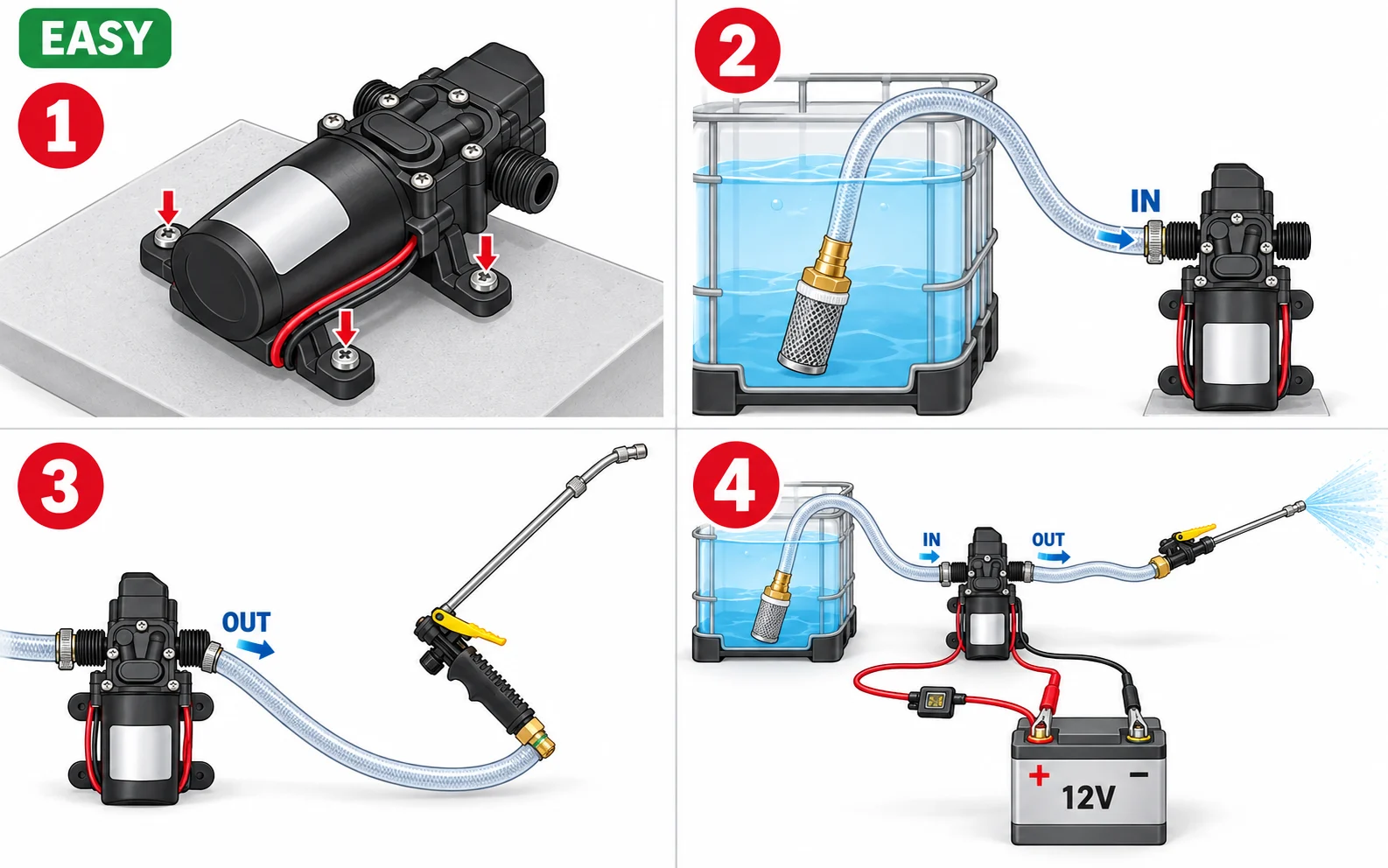
About 10 minutes with the pump, a tank, two hoses, and a battery. Our 12V Pump Sprayer Kit has the spray wand, the intake filter, and a fused battery clip cable in one box.
- Mount the pump on a flat, dry spot next to the tank, screwed down. Diaphragm pumps are self-priming, so the pump can sit beside or above the tank and pull the water up.
- Intake hose: from inside the tank (or the tank's outlet) to the pump's IN port. Push the intake filter into the tank end of the hose. Clear vinyl hose is fine on this side.
- Outlet hose: from the pump's OUT port to the spray wand. Use reinforced hose here: the outlet is under pressure and plain vinyl hose can balloon or burst. Put a hose clamp on every barb.
- Power: pump wires to the clip cable's ring terminals, red to red and black to black. Clip red to + and black to − on the battery.
- Prime and test: hold the wand open over the tank. The pump pulls the water through in a few seconds. Release the trigger and check that the pump stops (on pressure switch models), then check every fitting for drips.
Keep it working
- Strain what goes into the tank. Grit and undissolved powder stick in the pump's valves and cost you pressure. Rinse the intake filter when the flow drops.
- Run clean water through after every use: pump, hose, and wand. Follow the label of whatever you spray, including gloves and eye protection.
- Don't let it run dry for long. Switch off when the tank is empty.
- Unclip the battery when you're done.
- Before a freeze, drain the pump and hoses. Water left in the pump head can freeze and crack it.
Gear for this job
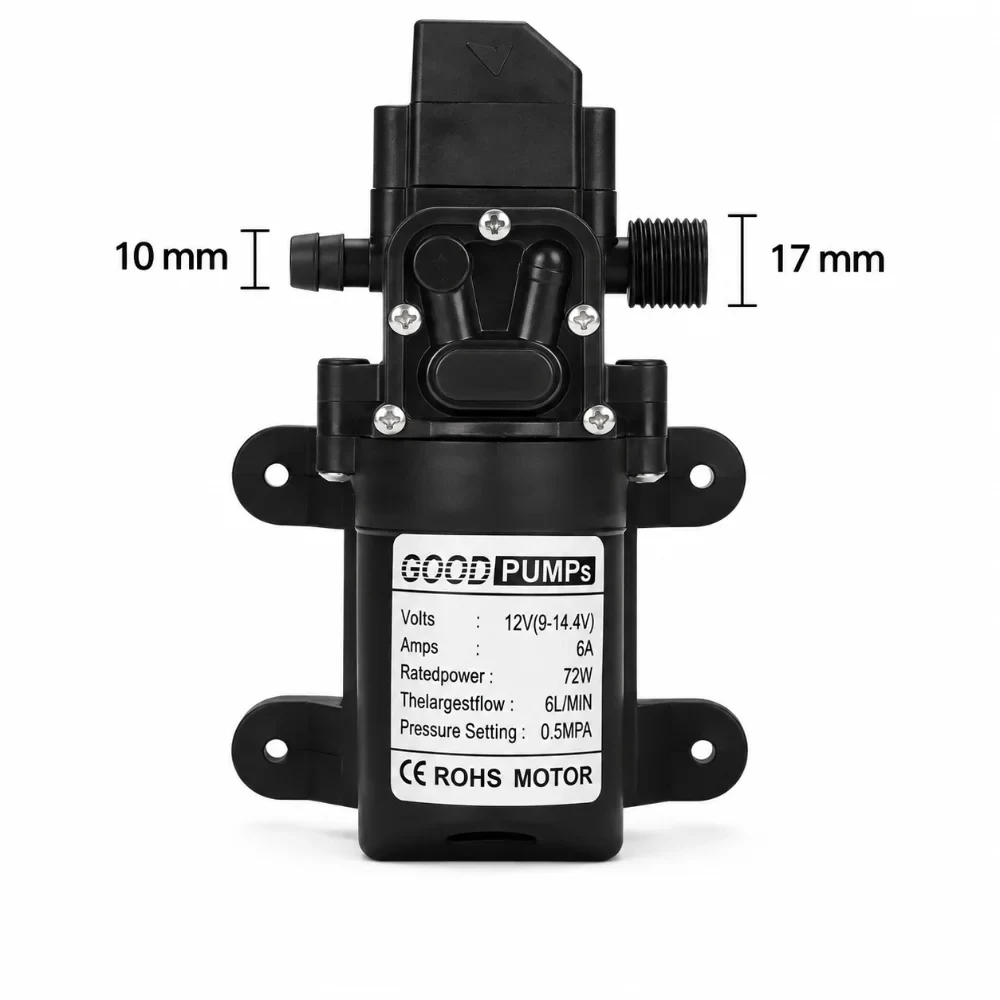 GOODPUMPS Compact 12V Pump1.3–1.6 GPM. Models C and D have a pressure switch.View product →
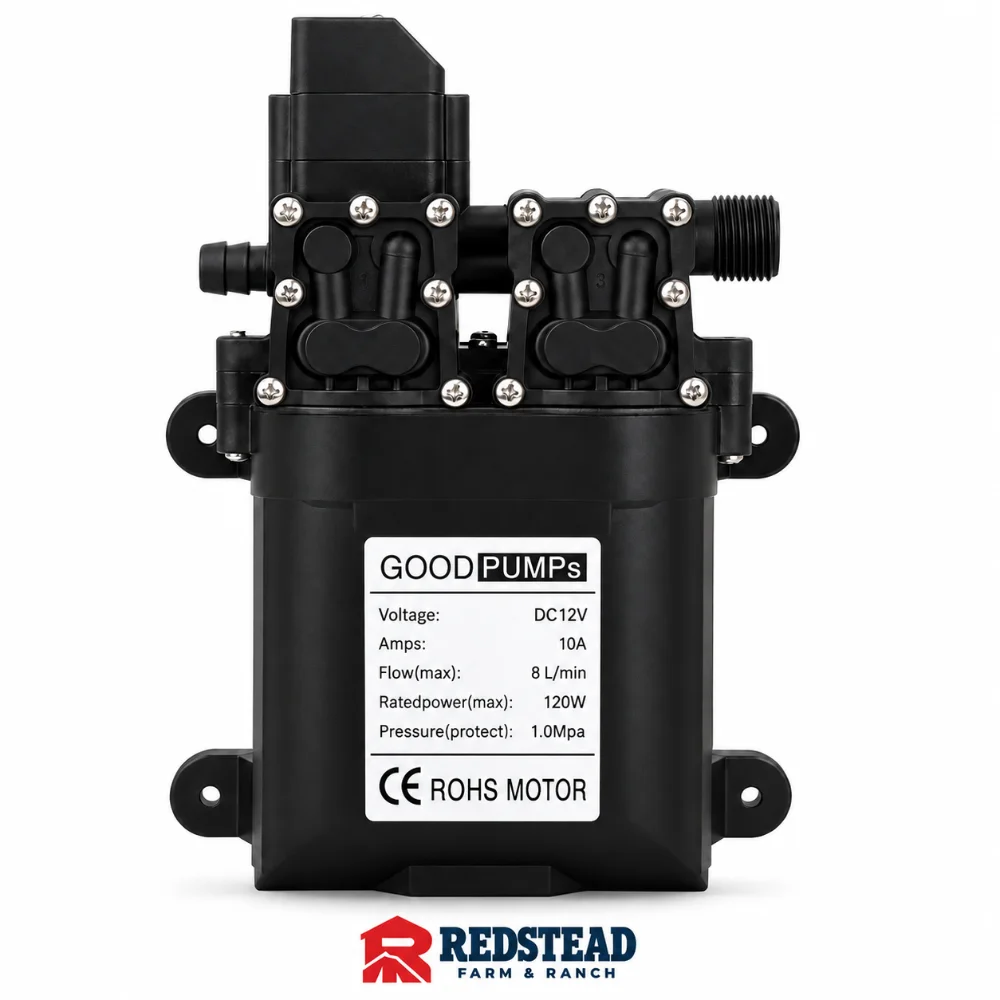 GOODPUMPS Heavy-Duty 12V PumpTwin head, 2.1 GPM, pressure switch at 145 PSI.View product →
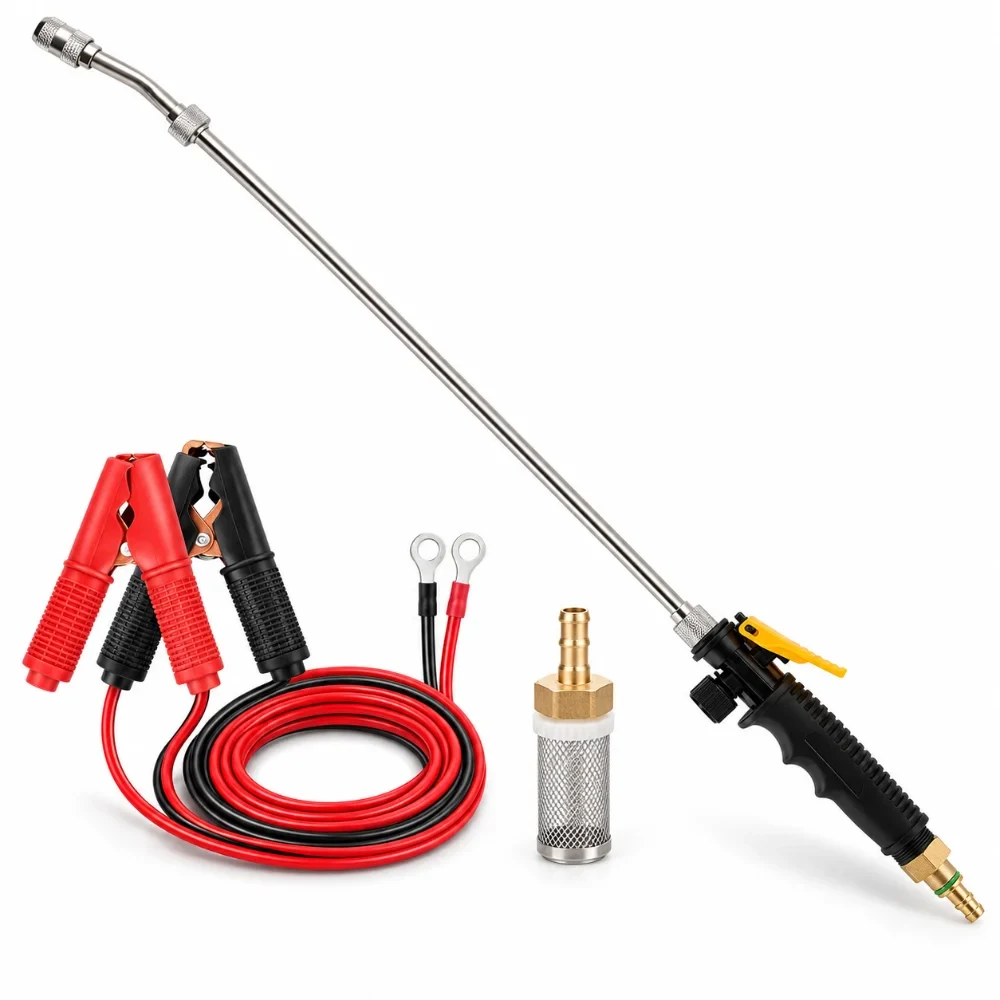 12V Pump Sprayer Kit29 in spray wand, intake filter, and fused battery clip cable.View product →
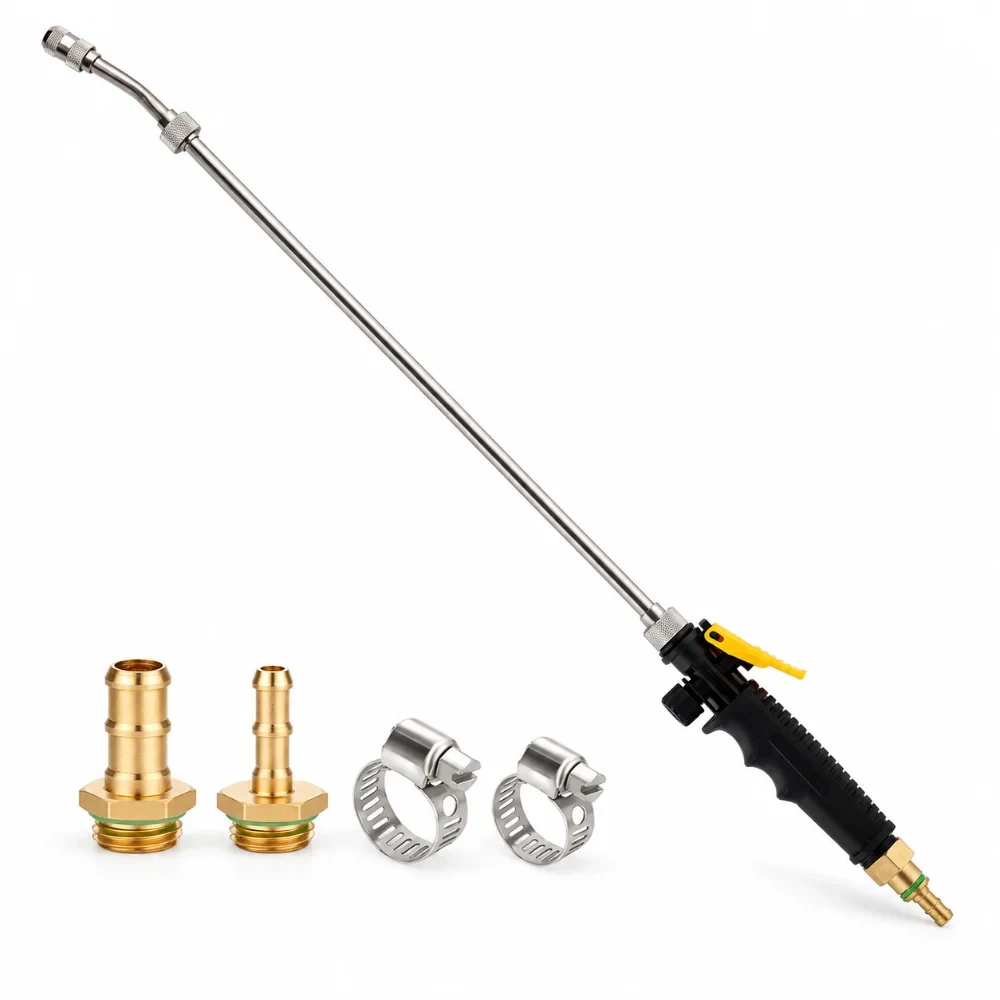 Spray Wand with TriggerLong 29 in wand or short 12 in gun. Stream to mist.View product →
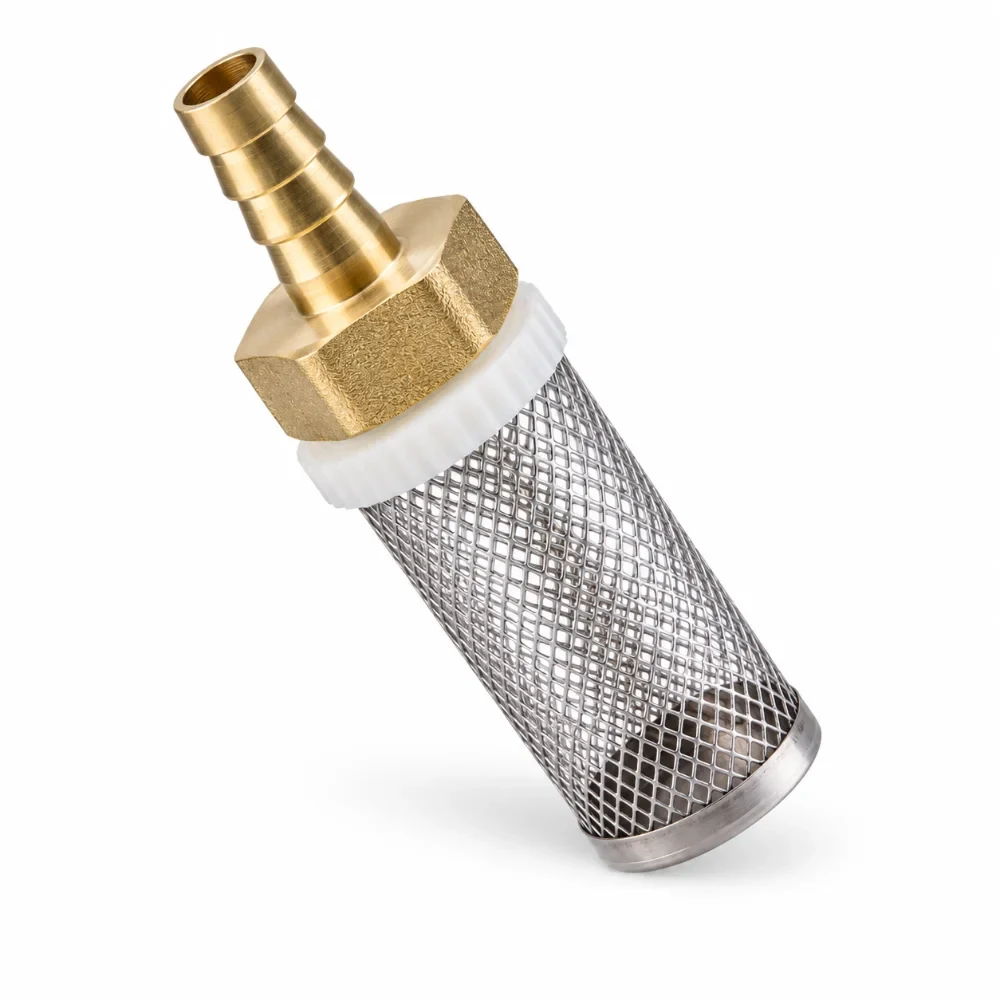 Pump Intake Filter, 3/8"Stainless mesh that keeps grit out of the pump.View product →
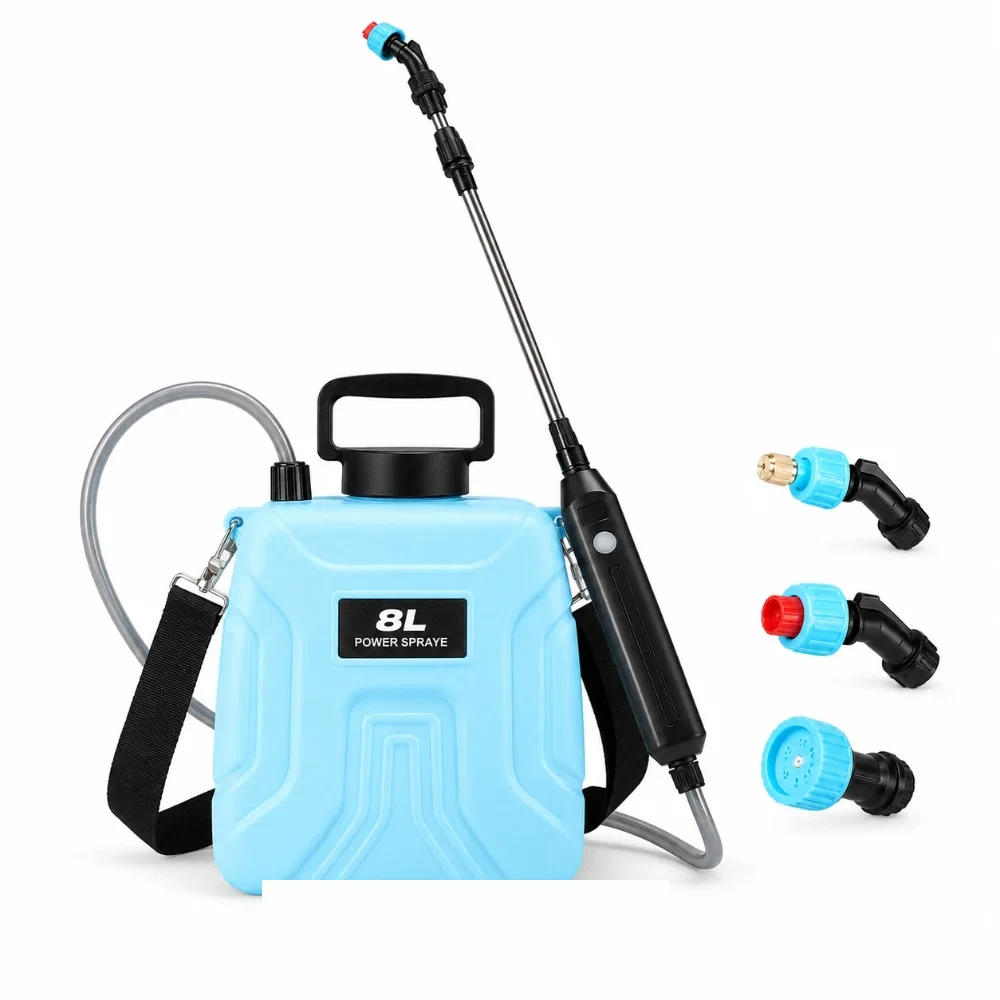 Battery Garden Sprayer, 2.1 galNo hand pumping, for small garden jobs.View product →
Questions
What size pump do I need for a 25 gallon sprayer?
The tank size doesn't decide the pump; the nozzles do. For one hand wand, a 1.3–1.6 GPM pump is plenty, whether the tank holds 15 or 60 gallons. Step up to about 2 GPM for long hoses or long days of spraying.
What PSI do I need for spraying weeds?
Most ground spraying is done at roughly 20–60 PSI. Higher pressure throws farther and makes finer droplets, which drift more. Turn it down near crops and gardens.
Why does my sprayer pump turn on and off by itself?
With the nozzle set to a very small flow, a pump with a pressure switch reaches its cut-off, stops, and restarts as the pressure drops. That pulsing is normal. If it cycles with the trigger closed, look for a leak or for air getting in on the intake side.
Can I use a 12V pump for weed killer and fertilizer?
Yes, that's what most 12V sprayer pumps are used for. Strain the mix, follow the product label, and run clean water through the pump, hose, and wand after every use.
Do I need a filter?
Yes. An intake strainer keeps grit and undissolved product out of the pump's valves, which is the most common reason a sprayer pump loses pressure.
Will the pump pull water up from the tank?
Yes. All GOODPUMPS diaphragm pumps are self-priming: they pull water up the intake hose from a tank beside or below them. Just make sure every intake fitting is tight, because an air leak on that side stops it from priming.
More guides
- How to wire a 12V water pump to a battery →
- How to pump water from a pond, creek, or rain barrel to your garden →
Tell us about your sprayer
Send us your tank size, hose length, and what you spray. We'll tell you which pump and fittings to get. Email [email protected] or text (703) 843-6988.
Shop sprayer pumps · Free U.S. shipping